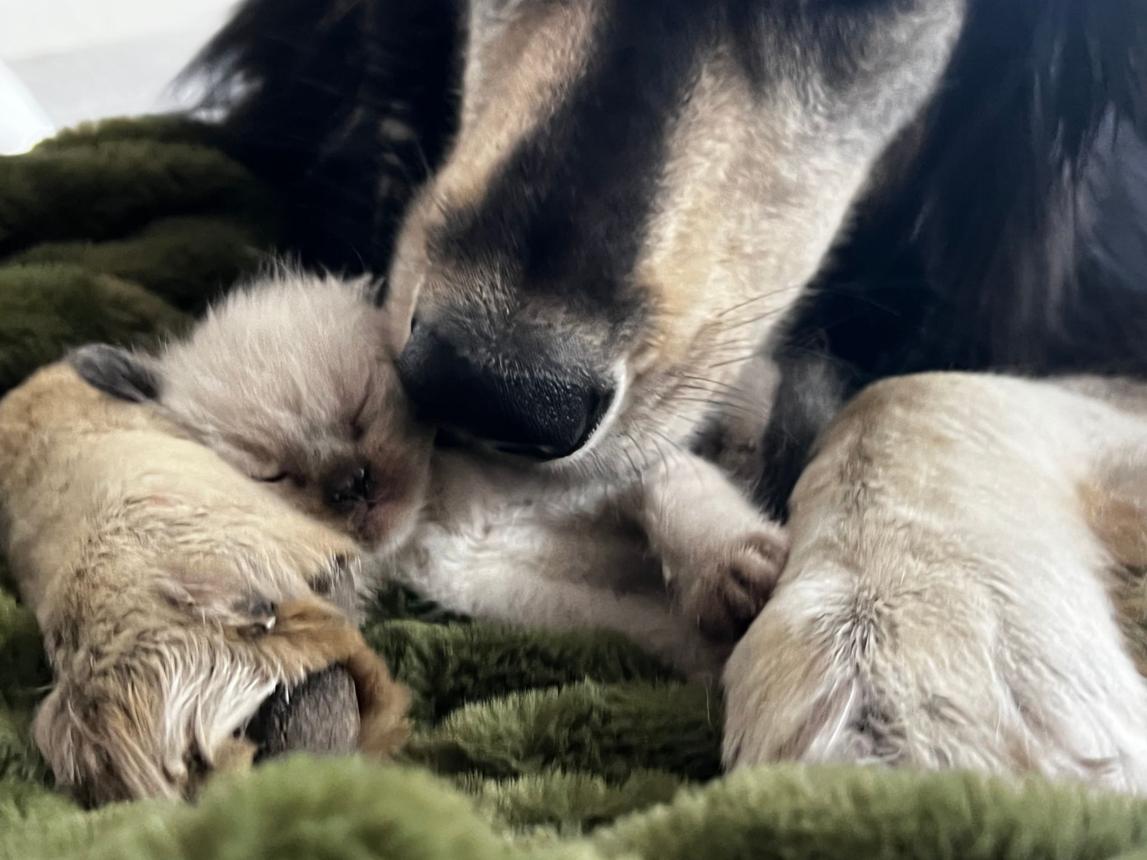


Here’s a completely new article with a fresh angle, new structure, and different examples from previous versions.
Not My Baby, Still My Responsibility: The Surprising World of Animal Foster Parents
Category
Wildlife & Animal Science
Introduction: The Family Tree with Missing Branches
When biologists discuss survival in nature, the conversation usually revolves around competition. Animals search for food, defend territory, avoid predators, and invest resources in passing their genes to the next generation.
That last point seems especially important. From an evolutionary perspective, raising offspring is expensive. It requires energy, time, and constant vigilance. Because of these costs, most scientists once assumed that parental care would be directed almost exclusively toward biological descendants.
Yet the natural world repeatedly challenges this assumption.
Across continents and ecosystems, researchers have documented extraordinary cases of animals raising, protecting, feeding, or adopting youngsters that are not their own. Some foster parents belong to the same species as the adopted child. Others belong to completely different species, creating family relationships that appear almost impossible.
These unusual stories reveal that animal parenting is far more flexible than we once believed. In many situations, the need to nurture can become stronger than the boundaries of genetics.
The World’s Most Unexpected Babysitters
Not every foster parent in nature becomes a full-time adoptive mother or father. Some animals simply help care for youngsters temporarily.
Among many social species, babysitting is surprisingly common.
Meerkats provide a well-known example. While dominant adults produce most of the offspring, other members of the group often guard, feed, and supervise pups. Youngsters may spend time with several caregivers throughout the day.
This system allows parents to search for food while knowing their babies remain protected.
Although the helpers are often relatives, the arrangement demonstrates that childcare in nature is not always limited to biological parents.
The Lioness That Ignored Her Instincts
Predators and prey are supposed to remain on opposite sides of nature’s relationship chart.
Yet wildlife researchers in Africa have occasionally observed lionesses behaving in astonishing ways around antelope calves.
Instead of hunting them, some lionesses have tolerated their presence, protected them from danger, and allowed them to remain nearby for extended periods.
These incidents remain rare, but they have fascinated scientists for years.
One possible explanation involves maternal hormones. A lioness that recently gave birth or lost her cubs may experience nurturing impulses so strong that they temporarily suppress predatory behavior.
For a brief moment, instinct and biology appear to collide.
Why Puppies Become Universal Adoptees
If there were an award for the animal most frequently adopted by other species, puppies would be strong contenders.
Monkeys, cats, goats, and even birds have been observed interacting with abandoned puppies in unusually protective ways.
Researchers believe puppies possess a combination of traits that encourage caregiving:
- Soft vocalizations
- Large eyes
- Playful behavior
- Dependence on adults
These characteristics resemble those found in many mammal infants.
As a result, puppies can trigger parental responses in animals that would normally have little reason to interact with them.
This may explain why stories involving adopted puppies appear in wildlife observations from several countries.
The Gentle Giants and Their Community Nursery
Elephants do not rely on a single parent to raise a calf.
Instead, an entire network of females often contributes to childcare. These helpers assist with protection, guidance, and supervision.
Young calves benefit from constant attention, while inexperienced females gain valuable parenting practice.
Researchers have observed orphaned calves receiving support from multiple members of the herd. In some cases, the loss of a mother does not mean complete abandonment because other females step in to help.
This collective system creates one of the most sophisticated childcare networks in the animal kingdom.


Penguins That Adopt by Accident
Penguin colonies are crowded places filled with thousands of adults and chicks.
In such chaotic environments, mistakes are inevitable.
A wandering chick may become separated from its parents and approach another adult seeking food or warmth. Surprisingly, some adults respond positively.
Researchers studying penguins have documented cases where unrelated chicks received care from foster parents.
Adults that lose their own eggs or chicks may be particularly likely to accept newcomers.
Although not every adoption succeeds, these incidents reveal how powerful parenting instincts can become.
The Curious Friendship Between Cats and Birds
Domestic cats are famous hunters, making certain adoption stories particularly remarkable.
Animal shelters and farms occasionally report mother cats caring for ducklings, chicks, or small birds. The babies rest beside the cat, follow her movements, and receive protection normally reserved for kittens.
Scientists believe maternal hormones play an important role in these situations.
Once a cat enters a caregiving state, vulnerable youngsters may be treated as dependents rather than prey.
These unusual families often attract widespread attention because they seem to violate the expected relationship between predator and prey.
Ocean Mothers and Lost Calves
The oceans contain their own examples of foster care.
Dolphins and whales live in complex social groups where cooperation is essential. Researchers have documented instances of females assisting calves that are not their biological offspring.
Some adults help guide young animals through the water, protect them from threats, or allow them to remain close to the group.
Because studying marine animals is difficult, scientists suspect many examples go unnoticed.
Nevertheless, available evidence suggests that cooperative caregiving may be more common in the ocean than previously believed.
Birds That Are Tricked Into Parenthood
Not every foster relationship develops naturally.
Some species exploit parental instincts through deception.
Cuckoos and cowbirds lay eggs in the nests of other birds, leaving foster parents to handle all childcare responsibilities.
The unsuspecting hosts incubate the eggs, feed the chicks, and protect them from predators.
Remarkably, the adopted chick often becomes larger than the adults raising it.
Even so, instinctive feeding responses continue to drive parental care.
This unusual strategy demonstrates how powerful caregiving instincts can be—and how easily they can be manipulated.
Capybaras: Nature’s Peacekeepers
Capybaras have become famous for their ability to coexist peacefully with other animals.
Birds perch on them. Ducks swim nearby. Small mammals often share their space without conflict.
Female capybaras frequently participate in communal childcare, helping supervise groups of young animals.
Their calm social behavior has earned them a reputation as one of the most tolerant species on Earth.
While true cross-species adoption remains uncommon, capybaras demonstrate how social flexibility can create opportunities for unusual relationships.


What Makes a Baby Look Like a Baby?
One fascinating reason foster parenting occurs involves the appearance of young animals.
Many species share features that automatically attract adult attention:
- Large eyes relative to body size
- Rounded heads
- Small noses
- Soft sounds
- Clumsy movements
These characteristics act as biological signals indicating vulnerability.
Scientists believe they help trigger protective behavior in adults.
Because these signals appear across many species, they occasionally encourage caregiving toward unrelated youngsters.
The Evolutionary Advantage of Helping
At first glance, raising another animal’s offspring seems wasteful.
Why spend valuable energy on a youngster that does not share your genes?
The answer depends on the species.
In social animals, helping others can strengthen group stability. Young helpers gain experience. Communities become more resilient. Orphaned youngsters may eventually contribute to the survival of the group.
Evolution is not solely about individual success.
In many cases, cooperation can provide significant long-term benefits.
A Different View of the Animal Kingdom
Stories about foster parenting challenge many common assumptions about wildlife.
Nature is often portrayed as a place of relentless competition. While competition certainly exists, cooperation plays an equally important role.
Animals form partnerships, share responsibilities, and sometimes care for unrelated young.
These behaviors reveal a side of the natural world that is often overlooked.
Rather than viewing animals as simple creatures driven only by instinct, researchers increasingly recognize the complexity of their social lives.
Conclusion
The phenomenon of animals raising children that are not their own remains one of the most fascinating subjects in behavioral science. From lionesses protecting antelope calves to dolphins assisting orphaned youngsters and penguins feeding unrelated chicks, examples of foster parenting appear across the natural world.
Some relationships arise from hormonal instincts. Others develop through social cooperation or unusual circumstances. A few remain difficult to explain.
Together, they reveal an important truth: family in nature is not always defined by genetics.
Sometimes, it is defined by care, protection, and the willingness to help a vulnerable young life survive.