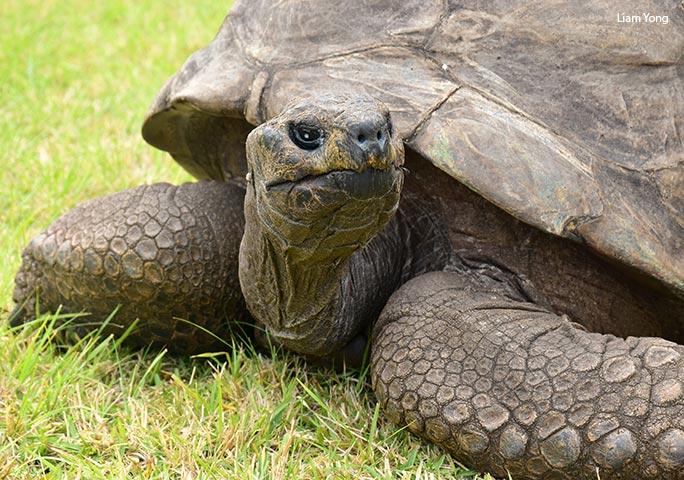


Meet Jonathan: The Oldest Living Land Animal Still Alive Today
Imagine living through the invention of the telephone, the first airplane flight, two World Wars, the arrival of television, the birth of the internet, and the rise of artificial intelligence.
Now imagine experiencing all of that without being a human.
On a remote island in the South Atlantic Ocean lives a remarkable creature that has witnessed more history than almost anyone alive today. His name is Jonathan, and he is recognized as the oldest known living land animal on Earth.
What makes Jonathan truly extraordinary is that he is not a whale, shark, or deep-sea creature. He is a giant tortoise that continues to live a peaceful life despite being nearly two centuries old.
His story has fascinated scientists, animal lovers, and historians around the world because he represents one of nature’s greatest mysteries: extreme longevity.
A Living Piece of History
Jonathan is a Seychelles giant tortoise, a species famous for its long lifespan. However, even among giant tortoises, Jonathan is exceptional.
Historical records indicate that he was already fully grown when he arrived on the island of Saint Helena in 1882. Since giant tortoises require decades to reach adulthood, experts estimate that Jonathan was born around 1832.
That means Jonathan has lived through nearly 200 years of world history.
To understand just how old that is, consider some events that had not yet happened when Jonathan was born:
- The automobile had not been invented.
- The telephone did not exist.
- Electric light bulbs were not in common use.
- The American Civil War had not begun.
- The Eiffel Tower had not been built.
- Airplanes were still unimaginable.
Yet Jonathan remains alive today.
Life on Saint Helena


Jonathan lives on Saint Helena, a remote volcanic island located in the South Atlantic Ocean.
The island is perhaps best known as the place where Napoleon Bonaparte spent his final years in exile.
For Jonathan, however, Saint Helena has been home for well over a century.
He spends much of his day wandering grassy fields, resting in the shade, and enjoying meals prepared by caretakers. Despite his age, Jonathan continues to move around regularly and interact with his surroundings.
Visitors from around the world travel to Saint Helena hoping to catch a glimpse of this living legend.
How Has Jonathan Lived So Long?
Scientists have long studied animals with exceptional lifespans, hoping to understand the secrets of aging.
Several factors may contribute to Jonathan’s remarkable longevity.
1. Slow Metabolism
Giant tortoises have extremely slow metabolisms. Their bodies use energy efficiently, which may reduce wear and tear on cells over time.
Because they move slowly and conserve energy, their biological systems experience less stress than those of many other animals.
2. Few Natural Predators
Adult giant tortoises are enormous and possess thick protective shells. This means they face relatively few threats once they reach maturity.
Animals that avoid predators often have more opportunities to evolve longer lifespans.
3. Stable Environment
Jonathan has lived in a protected environment for decades.
Regular food, veterinary care, and freedom from predators have likely contributed to his continued survival.
4. Genetics
Researchers suspect that giant tortoises possess unique genetic traits that help them resist age-related damage and disease.
Scientists continue studying tortoise biology in hopes of learning lessons that could one day benefit human medicine.
Remarkably Healthy for His Age
Many people assume an animal approaching 200 years old would be extremely weak or inactive.
Surprisingly, Jonathan continues to enjoy life.
Caretakers report that although he has lost much of his vision and sense of smell, he remains active and maintains a healthy appetite.
Veterinarians monitor his health closely and provide specialized care when necessary.
Jonathan particularly enjoys eating:
- Lettuce
- Apples
- Bananas
- Cabbage
- Carrots
- Seasonal fruits
His caretakers often hand-feed him to ensure he receives proper nutrition.
Considering his extraordinary age, his overall condition continues to amaze experts.
The Science of Extreme Longevity


Jonathan is part of a small group of animals known for exceptional lifespans.
Some species capable of extraordinary longevity include:
- Giant tortoises
- Greenland sharks
- Bowhead whales
- Ocean quahog clams
- Certain jellyfish species
Scientists are increasingly interested in understanding why some animals age much more slowly than others.
Research suggests that long-lived species may possess:
- Enhanced DNA repair systems
- Stronger cancer resistance
- Efficient cellular maintenance
- Reduced metabolic stress
These discoveries could provide valuable insights into aging and longevity across all species.
Witness to Nearly Two Centuries of Change
Perhaps the most fascinating aspect of Jonathan’s life is not simply his age but everything he has witnessed.
During Jonathan’s lifetime:
- More than 40 U.S. presidents have served.
- The industrial revolution transformed societies.
- Humans landed on the Moon.
- Computers were invented.
- The internet connected the world.
- Smartphones became common.
- Artificial intelligence emerged.
Few living creatures have observed such dramatic changes across generations.
Jonathan serves as a reminder of how brief human lives are compared with some of nature’s longest-lived animals.
Why People Around the World Love Jonathan


Jonathan has become much more than an animal record holder.
For many people, he symbolizes:
- Resilience
- Survival
- Patience
- Adaptability
- The wonders of nature
His story inspires curiosity about wildlife and encourages greater appreciation for conservation efforts.
As habitats disappear and species face increasing challenges, Jonathan reminds us of the importance of protecting Earth’s biodiversity.
Every species contains unique biological secrets that could help us better understand life itself.
Could Any Animal Live Longer?
Although Jonathan holds the title of the oldest known living land animal, some marine species may live even longer.
Scientists believe certain Greenland sharks can survive for several centuries, while some ocean-dwelling clams have been estimated to live for more than 500 years.
However, among land animals currently known to be alive, Jonathan remains unmatched.
His lifespan continues to astonish researchers and animal enthusiasts alike.
Conclusion
Jonathan the giant tortoise is far more than an old animal. He is a living connection to a world that existed nearly 200 years ago.
From the age of sailing ships to the era of artificial intelligence, Jonathan has quietly endured while civilizations transformed around him. His extraordinary life offers a rare glimpse into the mysteries of aging, survival, and the incredible resilience of nature.
As he continues grazing peacefully on the island of Saint Helena, Jonathan remains one of the most remarkable living creatures on Earth—a true survivor whose story reminds us that sometimes the greatest wonders of the natural world move at their own slow and steady pace.