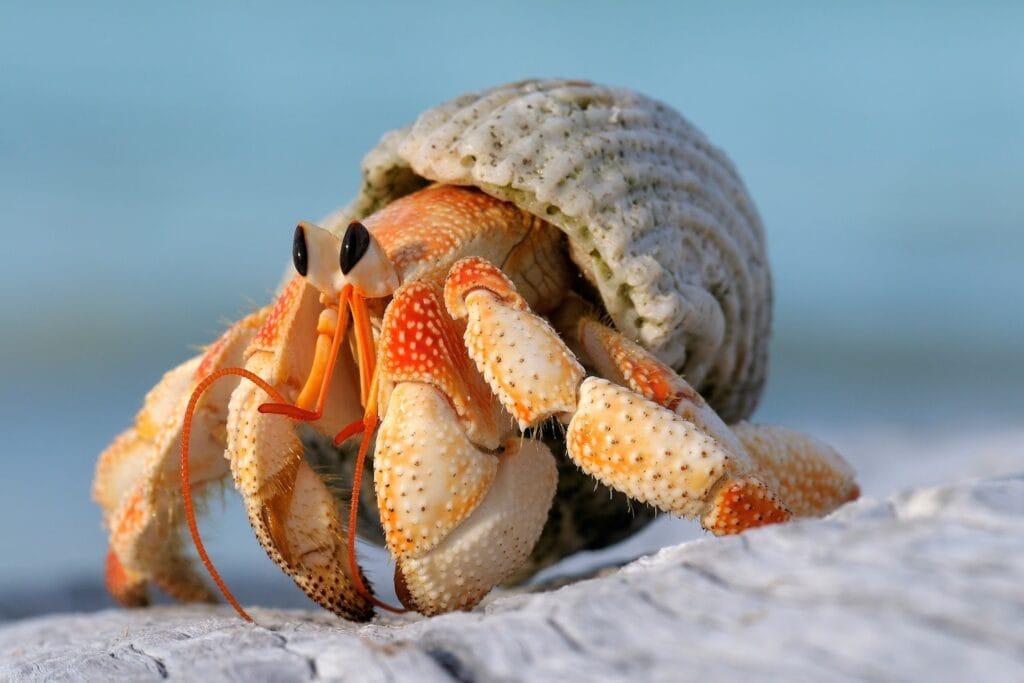


This Crab Doesn’t Build a Home—It Steals a Snail Shell and Lives Inside It
Imagine searching for a house not by building one—but by finding an abandoned shell and moving in.
That’s exactly how one of the ocean’s most unusual animals survives.
Hermit crabs are famous for using empty snail shells as portable homes. Unlike most crabs, their bodies are not fully protected by a hard outer shell. Instead, they depend on abandoned snail shells as mobile shelters, carrying their homes everywhere they go.
This strange lifestyle has turned hermit crabs into one of nature’s most fascinating examples of adaptation and survival.
Why Hermit Crabs Need Borrowed Homes
Most crabs have thick, armored bodies that protect them from predators and rough environments.
Hermit crabs are different.
Only the front part of their body is strongly protected. Their soft, curved abdomen remains vulnerable.
To solve this problem, evolution created an unusual strategy.
Hermit crabs search for empty snail shells and carefully move inside. Their curved bodies fit naturally into spiral interiors, creating a surprisingly secure shelter.
The shell becomes more than protection—it becomes the crab’s bedroom, fortress, and transportation system.
Without shells, many hermit crabs would struggle to survive.
The Great Shell Hunt
Finding the perfect shell is not easy.
Hermit crabs spend large portions of their lives evaluating potential homes.
A shell must be:
- Large enough to fit comfortably
- Light enough to carry
- Strong enough to resist predators
- Shaped correctly for balance and movement
Crabs inspect shells carefully before committing.
They rotate around openings, test the interior using their claws, and sometimes enter partially before deciding.
If a shell feels wrong, they quickly move on.
A poor shell choice may reduce movement speed or increase vulnerability.
Real Estate Competition Underwater
Suitable shells are valuable.
In some environments, shell availability becomes so limited that competition intensifies.
Researchers have observed hermit crabs gathering in groups whenever an empty shell appears.
Sometimes a chain of crabs forms—smallest to largest—waiting for a shell exchange.
When one crab upgrades to a larger shell, another immediately occupies the abandoned one, creating an orderly housing market beneath the sea.
This phenomenon is often called a “vacancy chain.”
Instead of fighting constantly, many crabs benefit from timing and opportunity.
Moving Day: One of Nature’s Fastest Decisions
Changing shells is risky.
During the transfer, a hermit crab briefly exposes its soft body.
Predators such as fish and octopuses may attack during these vulnerable moments.
Because of this danger, shell changes happen incredibly fast.
The crab positions both shells close together and performs a rapid switch that can take only seconds.
This quick relocation reduces exposure and increases survival.
Scientists studying shell exchanges continue discovering how accurately crabs judge shell size and quality.
More Than Protection: Shells Become Ecosystems
Over time, a hermit crab’s shell may become home to more than one creature.
Small algae, marine worms, and tiny organisms sometimes attach to the outside.
Some hermit crabs even develop partnerships with sea anemones.
The anemones gain transportation and access to food scraps.
The crab gains additional defense because anemones possess stinging cells that discourage predators.
What begins as a discarded snail shell can eventually become a tiny moving ecosystem.
Growing Means Constantly Moving
Hermit crabs never stop growing.
As they increase in size, their shells eventually become too small.
This means they must repeatedly search for larger homes throughout life.
Young crabs may switch frequently.
Older individuals can become extremely selective.
Growth creates constant pressure to find better housing.
In areas where snail populations decline or shells become scarce, hermit crab survival may also decrease.
Their entire lifestyle depends on the availability of abandoned shells.
Unexpected Intelligence in Tiny Creatures
Hermit crabs demonstrate surprisingly complex behavior.
Studies suggest they compare shell quality, remember locations, and evaluate future opportunities.
Some even wait strategically near larger crabs, expecting shell exchanges.
Their decisions balance energy use, protection, and long-term survival.
For such small animals, their behavior appears remarkably sophisticated.
Why Hermit Crabs Fascinate People
Part of the appeal comes from how relatable their behavior feels.
Humans search for homes.
Hermit crabs search for homes.
Humans upgrade when life changes.
Hermit crabs do the same.
Their unusual relationship with abandoned snail shells transforms something simple into one of the ocean’s most memorable survival stories.
Final Thoughts
Hermit crabs prove that survival doesn’t always require building something new.
By transforming abandoned snail shells into portable shelters, these animals created one of nature’s most elegant solutions to a difficult problem.
Every shell tells a story.
First, it belonged to a snail.
Then, after being abandoned, it became a traveling nest for a crab.
In the ocean, even an empty shell can begin a second life.
Image Alt Text
Figure 1:
Close-up of a hermit crab partially emerging from an empty snail shell on the ocean floor.
Figure 2:
Small hermit crab carrying a spiral snail shell while moving across sandy seabed.
Figure 3:
Hermit crab inspecting a larger shell before changing homes underwater.
Figure 4:
Several hermit crabs gathered together competing for available shells.
Figure 5:
Colorful hermit crab using an abandoned shell as a portable shelter.
Figure 6:
Macro view showing the detailed claws and shell opening of a hermit crab.
Figure 7:
Hermit crab walking across the seafloor carrying its protective shell
Leave a Reply