Strange Things About Animals Raising Children That Are Not Their Own


Strange Things About Animals Raising Children That Are Not Their Own
Introduction
The animal kingdom is often portrayed as a ruthless world where only the strongest survive. Predators hunt prey, competition is fierce, and survival instincts dominate daily life. Yet nature occasionally surprises us with remarkable acts of compassion that seem almost impossible. Across the globe, scientists and wildlife observers have documented extraordinary cases of animals caring for babies that are not their own—and sometimes not even their own species.
From lionesses adopting antelope calves to dogs nursing orphaned kittens, these unusual relationships challenge what we think we know about animal behavior. While some of these actions can be explained by biology and instinct, others remain mysterious. Why would a predator protect an animal it would normally hunt? Why would a mother risk her own resources to care for unrelated offspring?
Let’s explore some of the strangest and most fascinating examples of animals raising children that are not their own.
1. Lionesses Adopting Antelope Babies
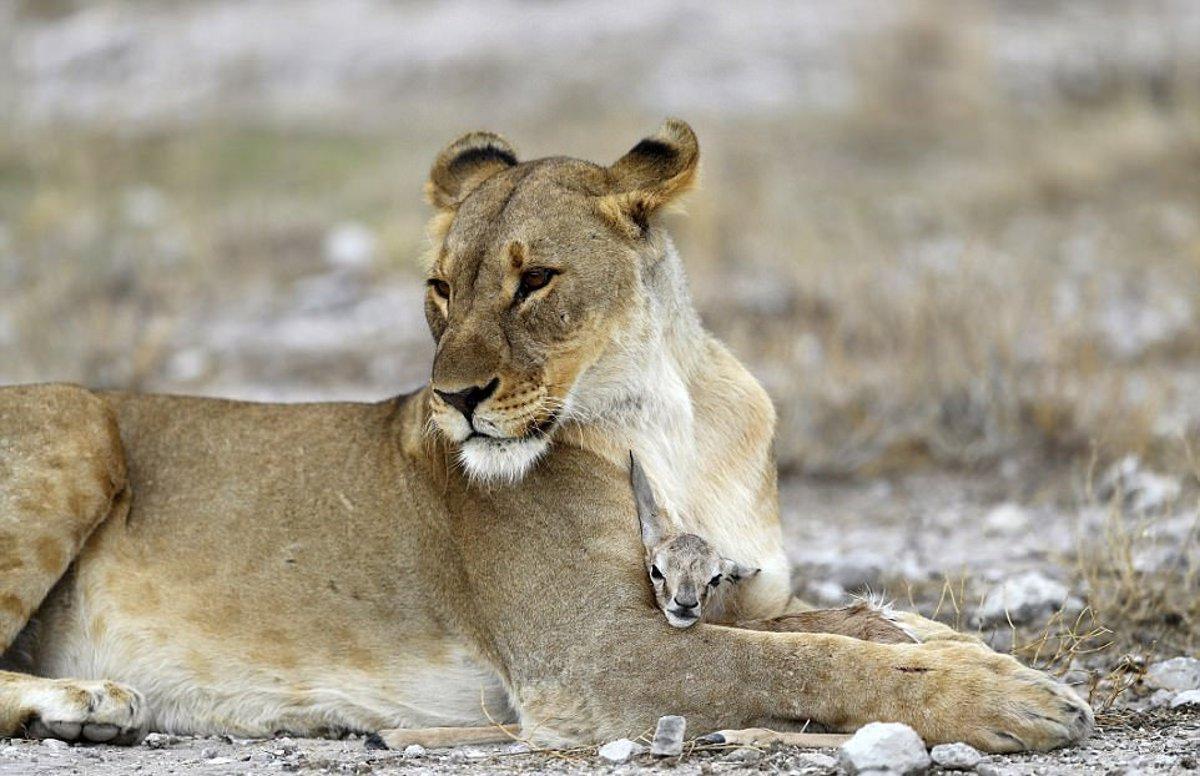
One of the most astonishing examples comes from the African savanna. Lions are among the world’s most feared predators, yet several documented cases show lionesses adopting young antelope calves.
In some instances, lionesses have been observed protecting orphaned antelope babies from other predators and allowing them to remain nearby for days or even weeks. Scientists believe that strong maternal instincts may temporarily override hunting behavior, especially when the lioness has recently lost her own cubs or is experiencing hormonal changes related to motherhood.
Unfortunately, these unusual adoptions rarely last forever. Eventually, the calf may wander away or become vulnerable to other predators. Nevertheless, the fact that a lion can switch from hunter to protector remains one of nature’s greatest mysteries.
Why It Happens
- Strong maternal hormones
- Loss of the lioness’s own offspring
- Confusion triggered by infant behaviors
- Temporary suppression of predatory instincts
2. Dogs Nursing Kittens
Domestic dogs are famous for their loyalty and affection, but some take caregiving to extraordinary levels. Around the world, there have been countless reports of mother dogs nursing orphaned kittens alongside their own puppies.
The relationship often develops naturally. Newborn kittens produce cries and behaviors similar to puppies, triggering the dog’s maternal instincts. Once accepted, the kittens receive warmth, protection, and nourishment just like biological offspring.
Veterinarians note that dogs and cats can form strong social bonds, especially when introduced at a young age. In these situations, species differences become less important than the instinct to care for vulnerable young animals.
3. Cats Raising Ducklings and Chicks
Equally surprising are stories of mother cats adopting ducklings, chicks, and even baby squirrels. Despite being natural hunters, many cats have demonstrated remarkable nurturing behavior toward animals they would normally consider prey.
Farmers have reported seeing hens and ducklings sleeping safely beside mother cats, who groom and protect them as if they were kittens. Researchers believe that once maternal instincts are activated, some cats respond to the babies’ helplessness rather than their species.
These unusual families often attract widespread attention because they appear to contradict everything people expect from predator-prey relationships.


4. Monkeys Adopting Puppies
In parts of Asia, wildlife photographers have documented monkeys adopting stray puppies. These relationships can be incredibly touching.
Adult monkeys have been seen carrying puppies through trees, sharing food, grooming them, and defending them from threats. In some cases, entire monkey groups accepted the puppy as part of their social community.
Scientists suggest that monkeys possess highly developed social instincts. Young animals often trigger caregiving responses, regardless of species. The puppy’s dependence and vulnerability may encourage protective behavior similar to that directed toward infant monkeys.
These unusual friendships demonstrate how complex and flexible animal emotions can be.
5. Dolphins Caring for Other Species
Dolphins are known for their intelligence and social behavior. They have repeatedly been observed helping injured animals, including whales, seals, and even humans.
In several documented cases, dolphins have protected young animals by surrounding them in defensive formations and guiding them away from danger. Some researchers believe dolphins possess advanced social awareness that allows them to recognize distress in other creatures.
Although dolphins may not formally “adopt” young animals, their willingness to assist unrelated species highlights a remarkable capacity for cooperative behavior.
6. Gorillas Caring for Orphaned Animals
Gorillas are among humanity’s closest relatives, and their nurturing behavior can be astonishingly human-like.
Wildlife caretakers have recorded gorillas showing curiosity, gentleness, and protective behavior toward birds, kittens, and other small animals. In captivity, gorillas have occasionally been observed watching over injured creatures and allowing them to remain nearby without aggression.
These behaviors provide insight into the emotional complexity of great apes and suggest that empathy may not be unique to humans.
7. Penguins Raising Unrelated Chicks
Penguin colonies often contain thousands of birds living close together. In such crowded environments, chicks sometimes become separated from their biological parents.
Researchers have observed adult penguins caring for abandoned chicks that are not their own. Foster parents may provide warmth, protection, and sometimes food.
This behavior increases the survival chances of orphaned chicks and demonstrates how cooperation can benefit entire colonies. While not all adoptions succeed, the willingness to care for unrelated young is remarkable.


Why Do Animals Adopt Unrelated Young?
Scientists have proposed several explanations for these surprising behaviors.
Maternal Instincts
Many female animals experience powerful hormonal changes after giving birth. These hormones can trigger nurturing responses toward any infant displaying the right signals, such as crying, small size, or helpless behavior.
Social Bonding
Highly social animals often form strong emotional connections. In some species, cooperation improves survival for the entire group.
Practice for Parenthood
Young or inexperienced animals may gain valuable parenting experience by caring for unrelated offspring.
Mistaken Identity
Sometimes animals simply cannot distinguish their own young from others, especially when infants share similar appearances or behaviors.
Empathy and Emotional Responses
Although controversial, some researchers believe certain animals experience forms of empathy that motivate them to help vulnerable individuals.
The Science Behind Cross-Species Parenting
Animal adoption challenges traditional ideas about evolution and survival. From a purely biological perspective, raising unrelated offspring appears costly because it requires time, energy, and resources.
However, evolution often favors behaviors that strengthen social groups and improve overall survival. In many species, helping others can indirectly benefit the community, increasing the chances that related individuals survive and reproduce.
Recent studies suggest that animal emotions may be more sophisticated than previously believed. While scientists remain cautious about attributing human emotions to animals, evidence increasingly shows that many species experience complex social and emotional lives.
Lessons Humans Can Learn
These extraordinary stories remind us that nature is not always governed by competition and conflict. Compassion, cooperation, and caregiving also play important roles in the animal kingdom.
When a lioness protects an antelope calf or a dog nurses orphaned kittens, we witness behaviors that blur the line between instinct and empathy. Such moments reveal that animals are capable of far more complexity than many people realize.
These examples also encourage us to view wildlife with greater respect. Every species possesses unique behaviors, relationships, and social structures that scientists are still working to understand.
Conclusion
The natural world is filled with surprises, and few are more heartwarming than animals raising young that are not their own. Whether driven by maternal instincts, social bonds, empathy, or biological confusion, these acts of caregiving challenge our assumptions about animal behavior.
From lionesses adopting antelope calves to monkeys caring for puppies, cross-species parenting demonstrates the remarkable flexibility of nature. These stories remind us that kindness and protection can appear in the most unexpected places—even among creatures separated by species, habitat, and instinct.
As researchers continue studying animal behavior, we may discover that the bonds connecting living creatures are far stronger and more complex than we ever imagined.
Leave a Reply