When Nature Becomes a Babysitter: The Strange World of Animals Raising Young That Aren’t Their Own


When Nature Becomes a Babysitter: The Strange World of Animals Raising Young That Aren’t Their Own
Category
Animals & Wildlife
Introduction
In the wild, survival is often described as a constant struggle. Animals compete for food, territory, and mates while avoiding predators and harsh environmental conditions. Because raising offspring requires enormous energy and resources, biologists have long assumed that most animals focus exclusively on their own young.
Yet nature repeatedly breaks its own rules.
Around the world, researchers, wildlife photographers, and animal caretakers have witnessed astonishing cases of animals caring for babies that do not belong to them. Some adopt orphaned youngsters from the same species. Others go a step further, nurturing completely different animals that they would normally ignore—or even hunt.
These unusual relationships reveal a side of the animal kingdom that many people rarely see. Instead of competition, we find cooperation. Instead of aggression, we see protection. And instead of strict biological boundaries, we discover surprising examples of cross-species caregiving.
Let’s explore some of the strangest and most fascinating cases of animals becoming parents to children that are not their own.
The Mystery of Adoption in the Wild
For humans, adoption is often a conscious decision. Animals, however, do not think about adoption in the same way. Their behavior is driven by instincts, hormones, social bonds, and environmental circumstances.
Scientists generally use the term “alloparenting” to describe situations where an animal cares for offspring that are not its own. This behavior appears in birds, mammals, fish, and even insects.
Sometimes the relationship develops because a baby loses its biological parents. In other cases, an adult animal simply responds to the cries and vulnerability of a young creature.
What makes these stories remarkable is that many of them seem to provide no obvious benefit to the caregiver.
Capybaras: The Babysitters of South America
Capybaras, the world’s largest rodents, have earned a reputation as some of the friendliest animals on Earth.
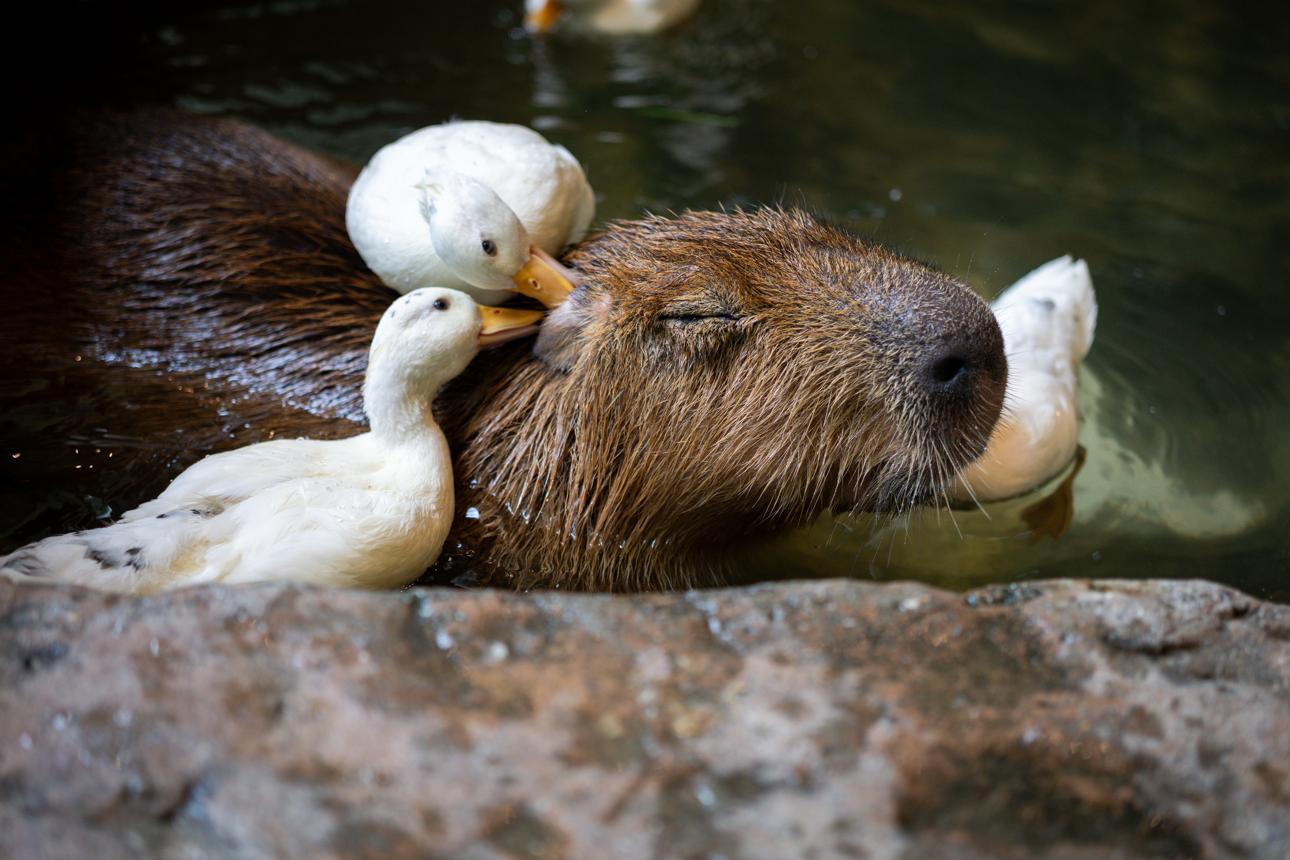
In South America, wildlife observers often report seeing ducklings, birds, rabbits, and even monkeys resting near capybaras without fear. Female capybaras frequently care for young that are not biologically theirs, creating what researchers call communal nurseries.
Several mothers may share responsibilities, allowing babies to move freely among the group. Any nursing female may allow another youngster to feed alongside her own offspring.
This cooperative system increases survival rates and creates one of nature’s most peaceful parenting communities.
Dogs That Become Foster Mothers
Domestic dogs have repeatedly demonstrated an incredible willingness to raise orphaned animals from other species.
Animal shelters around the world have documented mother dogs nursing kittens, piglets, fox cubs, and even baby squirrels. In many cases, the dog treats these newcomers exactly like her own puppies.
One reason is that newborn mammals often produce similar sounds and scents. These signals can activate maternal instincts regardless of species.
Once the bond forms, the foster mother may groom, protect, and comfort the adopted babies for months.
For animal rescue organizations, dogs sometimes become lifesaving surrogate parents when biological mothers are unavailable.
Monkeys and Their Unexpected Friendships
Among primates, caregiving behavior can be surprisingly flexible.
In several parts of Asia, monkeys have been observed adopting abandoned puppies. Photographs showing monkeys carrying puppies through villages have fascinated scientists and animal lovers alike.
The monkeys often share food, protect the puppies from danger, and keep them close throughout the day.
Researchers believe that infant-like features trigger nurturing responses in many primates. Large eyes, small bodies, and helpless behavior may encourage caregiving even when the young animal belongs to a different species.
These unusual friendships can sometimes last for months or even years.


Penguins That Accidentally Become Parents
Penguin colonies are crowded environments filled with thousands of birds.
During breeding season, confusion is common. Chicks sometimes wander away from their parents and become lost among neighboring families.
Scientists studying penguin colonies have observed adults feeding and protecting unrelated chicks. In some cases, adults whose own eggs failed to hatch have attempted to adopt abandoned youngsters.
These accidental adoptions may not always succeed, but they highlight how powerful parental instincts can be.
For penguins, the urge to care for a vulnerable chick may occasionally outweigh the ability to recognize biological relationships.
Elephant Compassion Beyond Family Lines
Elephants are famous for their intelligence and emotional complexity.
Wildlife researchers have documented elephants helping calves that are not part of their immediate family. Entire herds often work together to protect young members, regardless of direct parentage.
More surprising are reports of elephants showing protective behavior toward animals of different species.
In rare cases, elephants have been seen assisting injured animals or guarding vulnerable youngsters from predators.
Although these situations do not always involve long-term adoption, they reveal a remarkable willingness to care for creatures outside their closest social circles.
The Bird Species That Outsource Parenting
Not all strange parenting stories involve generosity.
Some birds have evolved a completely different strategy: convincing other species to raise their young.
The cuckoo is perhaps the most famous example. Female cuckoos secretly lay eggs inside another bird’s nest. When the cuckoo chick hatches, it often receives food and care from foster parents who never realize they are raising an impostor.
The foster birds invest weeks or months caring for a chick that is not genetically related to them.
This unusual reproductive strategy is one of nature’s most successful forms of deception.
Cats That Adopt Their Natural Prey
Cats are skilled hunters, which makes certain adoption stories especially surprising.
Animal shelters and farms occasionally report mother cats raising ducklings, chicks, rabbits, and squirrels.
Once maternal instincts are activated, some cats appear to view vulnerable babies as dependents rather than prey.
The adopted youngsters often sleep beside the cat, follow her movements, and receive the same grooming behavior given to kittens.
These cases demonstrate how caregiving instincts can temporarily override hunting behavior.
Why Do Animals Care for Unrelated Young?
Scientists continue investigating this question, but several explanations have emerged.
1. Hormonal Influences
After giving birth, hormones can create strong nurturing responses. These biological changes may cause an adult to respond positively to almost any infant.
2. Social Cooperation
In highly social species, helping young animals can strengthen group survival.
3. Learning Opportunities
Young females sometimes gain parenting experience by helping care for babies before having offspring of their own.
4. Mistaken Recognition
Animals do not always correctly identify which offspring belong to them.
5. Emotional Responses
Increasing evidence suggests some animals experience forms of empathy and social attachment more complex than previously believed.


Insects Have Foster Parents Too
Strange parenting is not limited to mammals and birds.
Certain ant species care for larvae that are not their own. Some even unknowingly raise the young of parasitic species that infiltrate their colonies.
Worker ants devote enormous effort to feeding and protecting these larvae, often without recognizing the difference.
This behavior demonstrates that caregiving can emerge in highly organized insect societies as well.
What These Stories Tell Us About Nature
For many years, people viewed animal behavior through a simple lens: survival and reproduction.
Modern research paints a more complicated picture.
Animals form friendships, cooperate with unrelated individuals, mourn losses, and sometimes care for young that offer no direct genetic benefit.
While scientists remain cautious about comparing animal emotions to human emotions, evidence increasingly suggests that social bonds play a major role in the lives of many species.
The stories of foster parenting and cross-species adoption challenge traditional assumptions about what motivates animal behavior.
The Most Surprising Lesson
Perhaps the most surprising lesson is that compassion—or at least behaviors resembling compassion—appears more widespread in nature than once believed.
A dog nursing abandoned kittens.
A monkey carrying a puppy.
A capybara surrounded by unrelated youngsters.
A penguin feeding an orphaned chick.
Each example reminds us that the animal kingdom cannot be reduced to simple rules.
Nature is filled with exceptions, and some of its most extraordinary moments occur when creatures choose care over conflict.
Conclusion
Animals raising young that are not their own remains one of the most fascinating behaviors in wildlife science. Whether driven by instinct, social cooperation, hormones, or emotional bonds, these acts reveal a surprisingly nurturing side of nature.
From mammals and birds to insects and marine animals, examples of foster parenting appear across the animal kingdom. Some relationships last only a few days, while others continue for months or years.
As researchers continue studying these remarkable behaviors, one thing becomes increasingly clear: the bonds between living creatures are often more flexible, complex, and extraordinary than we imagine.
The next time you think of nature as a world defined only by competition, remember the animals that became parents to babies that were never their own.
Leave a Reply